I want to address the most frequent questions I get asked: What is diastasis recti? Do you think I have it? What can I do about it?
I think this is probably the most common symptom that women are willing to talk about because it appeals to our vanity more than any of the other symptoms of a weak core.
Incontinence, prolapse, painful sex, these can all be hidden, not discussed in the open, maybe we can deal with them a little easier.
But an abdominal separation is harder to hide.
Let me be clear, you are NOT vain for wanting your core to be functional.
A strong core is vital for your whole body to function
This isn’t about getting a tight, toned belly. This is about making your core the strongest it’s ever been in order to complete your everyday activities without pain or dysfunction.
So, let’s talk about diastasis.
What is it?
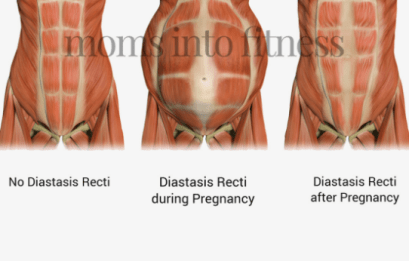
Diastasis recti abdominis (DRA) is a separation of the rectus abdominis “6-pack” muscles. This commonly happens to pregnant women but can affect anyone. During pregnancy, the rectus abdominis muscles separate and the fascia in between stretches and thins to accommodate the growing baby. This is a normal adaption of the body. For some women, this gap does not close after pregnancy. This can be a result of the impaired intra-abdominal pressure system.
How is it diagnosed?
While the research differs, DRA is generally defined as a gap of 2 cm or 2 finger widths wide for a postpartum woman. The depth of the separation also needs to be taken into consideration. This can be done in a self-diagnosis but should also be done by a healthcare professional. DRA is a separation anywhere along the linea alba. While it is often most common above the umbilicus, it can happen anywhere.
New research emphasizes that assessing the gap is not as important as assessing the individuals’ ability to generate tension in the linea alba.
How common is it?
In one study, 46% of women still had diastasis recti at 6 months postpartum and 32% had it at 1 year postpartum. That’s one in three women who likely struggle with DR!
How does it affect daily life?
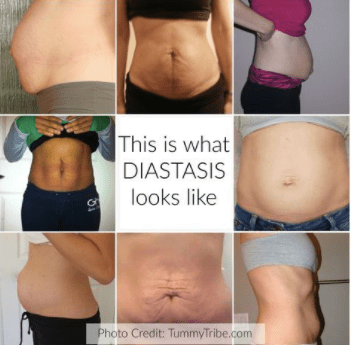
Women with diastasis recti may note the feeling of “flabby abs” or a weak core. I hear many moms complaining that they can’t lose their “mommy pooch” even though they’ve lost the baby weight. They also may feel the separation or notice a coning in the abdomen during certain movements. They may also have pelvic pain, low back pain, incontinence of urine or stool, or painful sex. Please note that the above symptoms can also be present without DRA.
How do I know if I’ll need surgery?
Here’s the good news: very few women actually need surgery to fix their separation! If your doctor suggests surgery, ask for a referral to see a women’s heath physiotherapist. Even if surgery is your final option, surgery is not a fix-all. You still need to learn techniques to strengthen your core!
How do I heal it?
Ah, the most important question. It’s not a simple as a few heel drops or glute bridges (although I do love these moves!). Healing your core requires a multi-faceted process. But, it’s simple, really! Simple, but not easy.
It is important to remember the DRA is a SYMPTOM of a weak core.
It is a symptom of a lack of function in the core. The entire core needs to be strengthened in order to address the DRA. Effective breathing in proper alignment can help regulate the impaired intra-abdominal pressure. The body needs to learn to reconnect with the innermost core, the diaphragm, transverse abdominis, and pelvic floor through core engagement, in order to heal DRA.
This core workout is safe for DRA.
Did this help you better understand diastasis recti? Do you have more questions? Let me know!
Janelle

