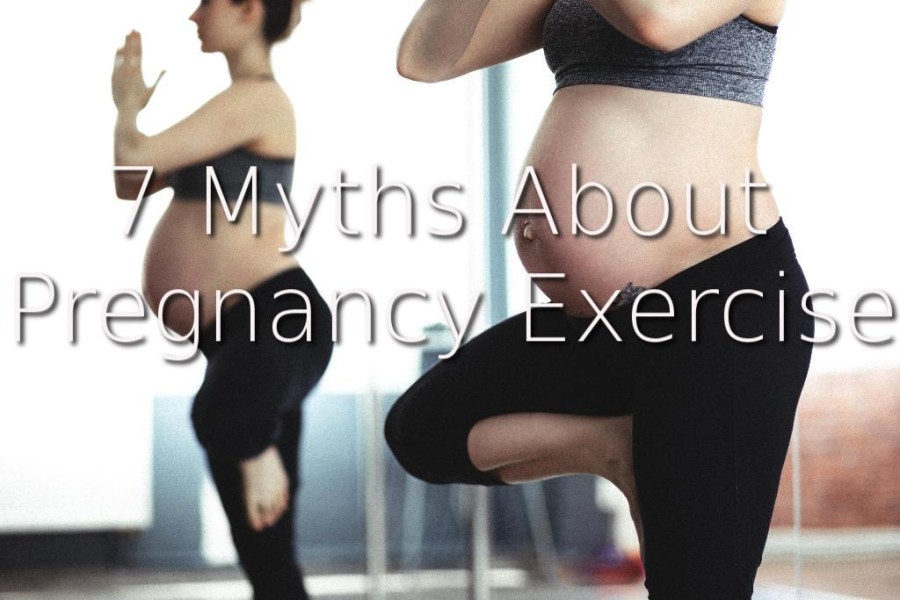
The benefits of exercising during pregnancy are numerous. Expecting moms who exercise may experience less pain and discomfort throughout pregnancy. Other benefits include decreased constipation, better sleep, and even a smoother labor and postpartum recovery! Also, let’s not forget the rush of endorphins that come from a sweat session.
Unfortunately, there are still some myths that surround exercising while pregnant. I want to address those, uncover the root of them, and give you tips on how to safely exercise during pregnancy!
Myth number 1: If you did the exercise before pregnancy, you can do it during pregnancy.
I’ve heard this one a lot. “If your body is used to doing it, you’re fine!” While this is true for many exercises, it’s not for all. Let’s not forget that our body is growing a baby here. There are some significant physiological changes happening and these need to be taken into consideration. Your core and pelvic floor (which is a part of your innermost core) are under a lot of pressure. Exercises that put pressure on your linea alba (that connective tissue between your 6-pack muscles), like crunches, sit-ups, v-sits, planks, should be avoided. Jumping exercises should be done with caution. Watch your stomach for coning. Pay attention to your breathing, are you able to breathe through the move? Or are you holding your breath? Are you leaking urine? Do you feel a pressure in your pelvic floor? All of these symptoms are your body reminding you that it may be too much right now.
Myth number 2: Pregnant women shouldn’t lift more than “x” amount of weight (15, 20, 25, etc., the numbers differ depending on the source)
Well, this is a nice thought but not even a possibility for many moms. Laundry, groceries, other children, these are often heavier than the set “limit”. We have no choice! For lifting, apply the same rules as above. If you can’t lift without holding your breath, coning of your abdomen, or leaking urine, stop and re-evaluate your strategy. There shouldn’t be a specific lifting limit for pregnant women, instead, they should be taught how to lift effectively and safely.
Myth number 3: Strenuous exercises could harm your baby.
The good news is, your baby is pretty safe in there. Generally, I like to advise my clients to use the “talk test”. You should be able to speak short sentences during your workout. If you can’t, dial it down a little. Research has shown that mothers who exercise at maximum intensity can see a 12% decrease in blood flow to the uterus. Blood flow would need to decrease by more that 50% in order to harm the fetus. Some exercises/activities that should be avoided: hot yoga, contact sports, anything that could potentially cause you to fall.
It’s actually your body that could suffer the consequences if you’re not careful. The main rule regarding the safety of your baby is not overheating or dehydrating your body. If you’re pregnant during the hot summer months, limit your workouts to early morning or try to stay indoors, where it’s cooler. Most importantly, stay hydrated. Take frequent water breaks.
Myth number 4: If you haven’t exercised before, there’s no point in starting now
This is never true! Should you start an intense training program after finding out that you’re pregnant? No, of course not. But, it is never too late to make a difference with exercising while pregnant. My advice would be to start slow. Start walking a few days per week and work up to some resistance based training. Labor and recovery will likely go much smoother if you’re in shape going into that postpartum time.
Myth number 5: You shouldn’t do any core work because you’re going to get a big belly anyways
Now you’re thinking, “she just told me no crunches or sit-ups but I should be doing core work?” Absolutely! There is so much more to working your core than laying on your back. Working your core is crucial to being ready for childbirth and postpartum. A strong core can help prevent back pain and pelvic pain. Don’t forget that your pelvic floor is also a part of you core. Pregnancy core work is not about getting abs, it’s about challenging your local stability system. I love to challenge my core with moves like off-loading my weights when doing certain exercises. Remember to practice your deep breathing. Any exercise is a core exercise if you’re doing it properly!
Myth number 6: Keep your heartrate below 140 beats per minute.
I still hear this one occasionally. The American College of Obstetricians and Gynecologists (ACOG) no longer makes this recommendation. As long as you’re staying hydrated and watching for symptoms such as: bleeding, dizziness, muscle weakness, headache, chest pain, regular painful contractions, or calf pain/swelling, you should not have to pay close attention to your heartrate.
Myth number 7: If you’re already exhausted, exercising will only make it worse.
You were up 5x going to the bathroom last night, your toddler decided 5:30am was a good time to start her day, and you’re growing another human. I get it. I do not like the “no excuses” mindset because I think it’s condescending. However, I also know a short workout can actually boost energy levels. On these days, just focus on 10 minutes. Or find a little time to do some stretching. You might find you start sleeping better (despite those bathroom trips). And, on days where you did get more sleep, and you know you actually do have some extra time, commit to a half hour! You’ll be surprised at how much better you feel!
I hope this addressed some of your concerns about pregnancy! Don’t hesitate to reach out if you have any questions!
Love,
 Janelle A Fitness